

An experienced ERISA attorney can help protect your retirement benefits.
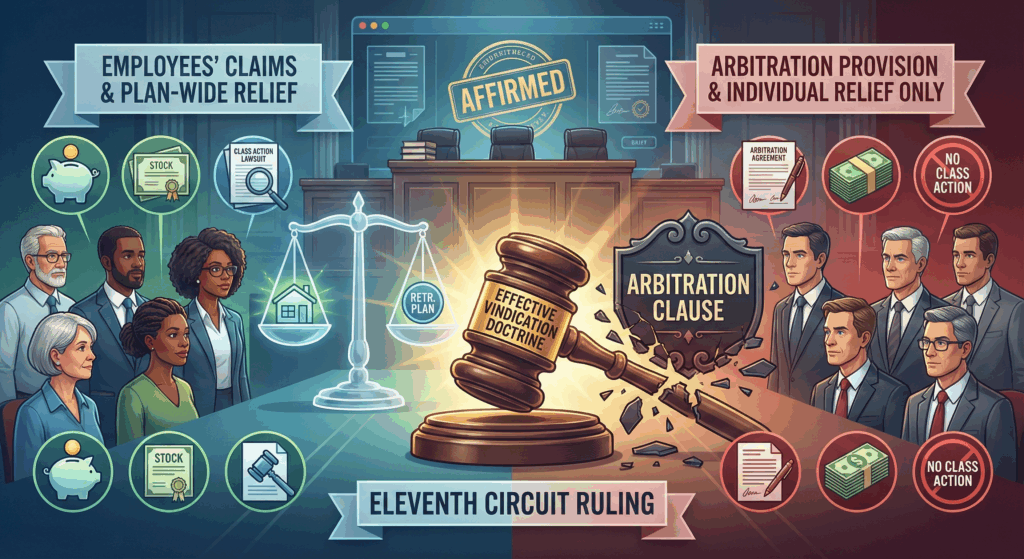
On December 15, 2025, the U.S. Court of Appeals for the Eleventh Circuit issued a decision in Williams v. Shapiro that addresses the enforceability of arbitration provisions in ERISA-governed employee benefit plans. The court held that an arbitration clause preventing plan participants from seeking plan-wide relief violated the effective vindication doctrine and was therefore unenforceable. This decision aligns the Eleventh Circuit with six other federal appellate circuits that have reached similar conclusions in ERISA fiduciary breach cases.
Case Background
A360, Inc., a mortgage services and consulting company, established an employee stock ownership plan (ESOP) in 2016. In January 2017, the ESOP purchased one million shares of A360 stock for $30 million, making the plan the company’s sole owner.
In September 2019, A360 and its trustee, Argent Trust Company, sold the ESOP’s shares to A360 Holdings, LLC for approximately $34.6 million. On the same date, A360 amended the plan document to add an arbitration provision titled “ERISA Arbitration and Class Action Waiver”. Five days later, the company terminated the plan. Between October 2019 and December 2021, the plan distributed proceeds to participants, after which the plan held no assets.
In September 2022, five plan participants filed a class action lawsuit on behalf of approximately 280 plan participants. The plaintiffs alleged that the defendants caused the plan to sell its shares for $34.6 million when the stock was actually worth approximately $70 million, resulting in a $35.4 million loss to the plan.
The complaint asserted multiple ERISA claims, including prohibited transactions under 29 U.S.C. § 1106, breaches of fiduciary duties of prudence and loyalty under § 1104(a)(1), and co-fiduciary liability under § 1105(a). The plaintiffs sought plan-wide relief, including disgorgement of profits and restitution for losses to the plan.
The Arbitration Provision
The arbitration provision added to the plan document contained several key limitations. It required that all covered claims “must be brought solely in the Claimant’s individual capacity and not in a representative capacity or on a class, collective, or group basis”. The provision further specified that claimants could not “seek or receive any remedy which has the purpose or effect of providing additional benefits or monetary or other relief to any individual or entity other than the Claimant”.
For claims brought under ERISA Section 502(a)(2) seeking relief under Section 409, the provision limited remedies to: (i) alleged losses to the claimant’s individual account; (ii) a pro-rated portion of profits made through use of plan assets intended to remedy only the claimant’s individual account; and (iii) other equitable relief that did not result in benefits or monetary relief to anyone other than the claimant.
District Court Proceedings
The defendants moved to compel arbitration based on the plan amendments. The district court denied the motion. The arbitration procedure was unenforceable because it prohibited the plan-wide relief that ERISA expressly authorizes. Because the provision was non-severable by its own terms, the district court invalidated it entirely.
The Eleventh Circuit’s Analysis
Application of the Effective Vindication Doctrine
The Eleventh Circuit reviewed the district court’s decision de novo and began by addressing whether the effective vindication doctrine applies in the ERISA context. The effective vindication doctrine, recognized by the Supreme Court in multiple decisions, invalidates arbitration provisions that prospectively waive a party’s right to pursue statutory remedies. The key inquiry is whether “the prospective litigant effectively may vindicate its statutory cause of action in the arbitral forum”.
Although the Supreme Court has not applied the doctrine to invalidate an arbitration provision in an ERISA case, six federal circuit courts have done so in recent years. The Eleventh Circuit noted that the doctrine has substantial support in Supreme Court precedent and federal common law, and that no circuit has rejected its application to ERISA cases. The court therefore adopted and applied the effective vindication doctrine.
ERISA’s Plan-Wide Relief Framework
The court examined ERISA’s statutory framework for fiduciary breach claims. Under Section 409(a), a fiduciary who breaches their duties “shall be personally liable to make good to such plan any losses to the plan resulting from each such breach, and to restore to such plan any profits of such fiduciary which have been made through use of assets of the plan”. Section 502(a)(2) provides that plan participants may bring civil actions for relief under Section 409.
The Supreme Court has interpreted these provisions as primarily concerned with “the possible misuse of plan assets, and with remedies that would protect the entire plan, rather than with the rights of an individual beneficiary”. Section 409(a) provides relief “singularly to the plan” rather than to individual plaintiffs, and Section 502(a)(2) claims are “brought in a representative capacity on behalf of the plan as a whole”.
The Eleventh Circuit explained that under this statutory framework, plan participants serve as agents litigating on behalf of the plan when they bring Section 502(a)(2) claims. The Supreme Court has recognized that “non-class representative actions in which a single agent litigates on behalf of a single principal are part of the basic architecture of much of substantive law”.
The Arbitration Provision Eliminated Statutory Rights
The court concluded that the arbitration provision plainly prohibited claims brought “in a representative capacity” and claims seeking remedies that would benefit anyone other than the individual claimant. This language prevented plaintiffs from effectively vindicating their statutory rights under ERISA Sections 409(a) and 502(a)(2).
The court rejected the defendants’ argument that plaintiffs retained their statutory rights because they could still seek individualized relief in arbitration. The fact that plan participants may obtain some individualized relief under Section 409(a) does not mean they waive the right to bring representative-capacity claims seeking relief on behalf of the plan.
The defendants’ reliance on Thole v. U.S. Bank, N.A., 590 U.S. 538 (2020), was unpersuasive. Thole involved a defined benefit plan and addressed Article III standing requirements, holding that plan participants lacked standing when alleged plan mismanagement did not affect their pension benefits. The decision did not address whether ERISA Section 502(a)(2) claimants can act as agents or proxies of the plan in representative actions.
The court also found that the fourth amendment to the plan, which permitted claimants to seek certain injunctive relief, did not cure the provision’s defects. Allowing plan-wide injunctive relief “has no bearing on the fact that it eliminates statutorily created plan-wide monetary relief”. The provision still prohibited representative capacity claims for disgorgement of profits and restitution to the plan—the primary forms of relief sought by the plaintiffs.
Severability Analysis
The Court held that the arbitration provision was not severable. The express language of the provision made clear that the parties intended the arbitration requirements to stand or fall together. Accordingly, the court invalidated the entire arbitration provision.
Significance of the Decision
Consensus Among Federal Appellate Courts
The Williams decision represents the seventh federal circuit to apply the effective vindication doctrine to invalidate ERISA arbitration provisions that prevent plan-wide relief. The Second Circuit reached this conclusion in Cedeno v. Sasson, 100 F.4th 386 (2d Cir. 2024). The Third Circuit decided similarly in Henry v. Wilmington Trust, 72 F.4th 499 (3d Cir. 2023). The Sixth Circuit has issued multiple decisions on this issue, most recently in Parker v. Tenneco, 114 F.4th 786 (6th Cir. 2024). The Seventh Circuit addressed the question in Smith v. Board of Directors of Triad Manufacturing, 13 F.4th 613 (7th Cir. 2021). The Ninth Circuit joined these courts in Platt v. Sodexo, 148 F.4th 709 (9th Cir. 2025). The Tenth Circuit ruled on the issue in Harrison v. Envision Management, 59 F.4th 1090 (10th Cir. 2023).
No federal appellate court has reached a contrary conclusion. This emerging consensus provides clear guidance regarding the enforceability of arbitration provisions in ERISA plans.
Implications for ERISA Plans
The decision has several implications for ERISA-governed employee benefit plans. Plan sponsors cannot use arbitration provisions to eliminate participants’ statutory rights to seek plan-wide relief under ERISA Sections 409(a) and 502(a)(2). Arbitration provisions that prohibit representative capacity claims or limit remedies to individual account losses are likely unenforceable in the Second, Third, Sixth, Seventh, Ninth, Tenth, and Eleventh Circuits. An ERISA attorney can help plan participants understand these protections.
The decision is particularly relevant for employee stock ownership plans, where fiduciary breaches affecting plan-wide stock valuations can significantly impact all participants’ retirement savings. The ability to bring representative actions seeking full recovery of plan losses serves as an important mechanism for holding ESOP fiduciaries accountable.
Consult an Experienced ERISA Attorney
ERISA litigation involves complex statutory and regulatory requirements. Plan participants considering ERISA claims should consult with an ERISA attorney experienced in employee benefits law to ensure their rights are protected.
The Garner Firm has extensive experience representing plan participants in ERISA litigation, including fiduciary breach claims, benefit denials, and disputes involving retirement plans. The firm’s founding attorney, Adam H. Garner, previously served as Administrator of two large multiemployer employee benefit plans and as President and CEO of their captive third-party plan administration business. This background provides insight into plan operations and fiduciary obligations.
Mr. Garner has handled ERISA cases in state and federal courts nationwide, including claims for benefits and equitable relief under ERISA Section 502(a) and fiduciary breach litigation. He is recognized as a Pennsylvania SuperLawyer and serves as a Senior Editor of the Bloomberg BNA treatise Employee Benefits Law. He regularly speaks and writes on ERISA litigation topics.
Contact Information
Plan participants who believe their retirement plan has been mismanaged or who have received benefit denials may benefit from a legal consultation. The Garner Firm offers consultations to discuss ERISA claims and evaluate legal options. The firm can be reached at (267) 805-6557 or through the firm’s website at www.garnerltd.com. Contact us today.
The information in this blog post is provided for educational purposes only and does not constitute legal advice. Readers should consult with qualified legal counsel regarding specific ERISA claims or disputes.