

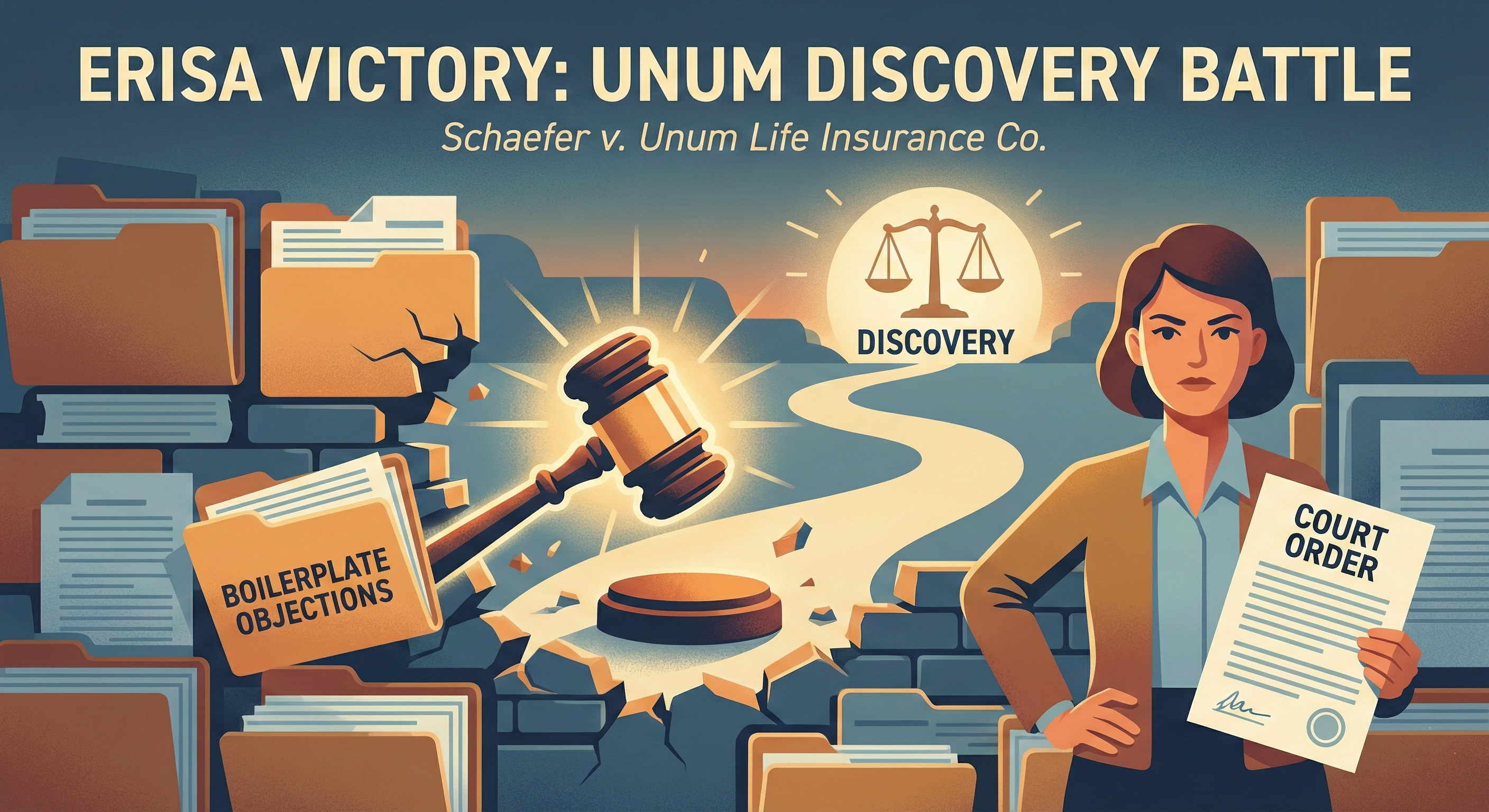
If you are fighting Unum Life Insurance Company of America over a denied or terminated long-term disability (LTD) claim, a recent federal court decision offers hope. Specifically, a ruling from the Middle District of Pennsylvania provides a clear roadmap for what claimants can—and cannot—obtain during ERISA discovery. As a result, an experienced ERISA long-term disability attorney can help you use this decision to your advantage.
In Schaefer v. Unum Life Insurance Company of America, No. 4:24-CV-00590 (M.D. Pa. Feb. 12, 2026), Chief United States District Judge Matthew W. Brann granted in part a motion to compel discovery against Unum. In doing so, he delivered a pointed rebuke of the insurer’s blanket, boilerplate objections. As a result, this ruling sets a valuable precedent for any ERISA long-term disability attorney who represents claimants against large insurers.
The Case: What Happened to Barbara Schaefer?
Barbara Schaefer filed suit against Unum after the company terminated her long-term disability benefits. Her amended complaint raised six claims. Specifically, these included breach of contract, bad faith insurance practice, improper denial of benefits, and breach of fiduciary duties under ERISA—the Employee Retirement Income Security Act of 1974.
During discovery, Schaefer served interrogatories and document requests on Unum. In particular, she sought information in several key areas: compensation data for the claims adjusters and medical reviewers who handled her file; the approval-and-denial track records of those employees; internal policies governing claims handling; details about Unum’s relationship with Dane Street, LLC, a third-party medical review firm; and communications from agencies that had looked into Unum’s LTD claims handling.
In response, Unum listed eight “general objections” and worked them into every single answer. For example, these boilerplate objections claimed the requests were overly broad, unduly burdensome, privileged, and vague. On top of these blanket objections, Unum raised specific objections to particular requests. Moreover, the insurer repeatedly directed Schaefer to the “claim file” as the source for the information she sought.
The Court Strikes Down Unum’s Boilerplate Objections
Judge Brann wasted little time disposing of Unum’s general objections. Citing the Third Circuit’s decision in Grider v. Keystone Health Plan Central, Inc., 580 F.3d 119, 139–40 (3d Cir. 2009), the court deemed all eight general objections waived. In short, the court explained that Unum had “clearly interposed” these objections to shield a large volume of otherwise discoverable material.
Furthermore, the court stressed that a defending party cannot push the burden of sorting through generic objections onto the court. Notably, Judge Brann observed that this pattern of boilerplate objections “appears to be a fairly typical practice for Unum.” Indeed, the court cited multiple prior decisions from other courts—including Dwyer v. Unum Life Ins. Co. of Am., 470 F. Supp. 3d 434, 438 (E.D. Pa. 2020).
What Discovery Did the Court Allow?
After clearing the boilerplate hurdle, the court turned to Unum’s specific objections. Overall, the results were nuanced. These rulings show why having a skilled ERISA long-term disability attorney matters during litigation.
- Incentive and Bonus Information: The court compelled Unum to disclose whether any incentive, bonus, or reward programs existed for employees who reviewed Schaefer’s claim. This included both internal claims adjusters and Dane Street medical staff. Schaefer alleged that Unum “pressures claim personnel to terminate claims” and rewards cost-saving employees. As a result, the court found these claims justified discovery into the incentives behind the review process. However, the court declined to require Unum to produce specific dollar amounts of employee pay. Instead, the court reasoned that raw figures did not justify the burden. Notably, the court still allowed Schaefer to explore pay details during depositions to probe potential bias.
- Review Policies and Procedures: The court also granted discovery into Unum’s internal claims review procedures and supervisory structure. These documents were directly relevant to Schaefer’s bad faith claims. In particular, they addressed her claims that Unum failed to put safeguards in its claims-handling process. However, the production was limited to procedures at play in Schaefer’s specific claim denial.
- Dane Street Information: In addition, the court compelled Unum to produce details about Dane Street personnel’s role in Schaefer’s claim denial. This included whether incentive-based pay existed. However, the court denied Schaefer’s request for all communications between Unum and Dane Street over three years. Ultimately, the court found this request too burdensome and lacking relevance to her individual claims.
What Discovery Did the Court Deny?
- Batting Average Data: Schaefer sought data showing how often each reviewer found claims to be supported by medical evidence. However, the court denied this request. It followed the Third Circuit’s guidance in Reichard v. United of Omaha Life Insurance Company, 805 F. App’x 111, 116–17 (3d Cir. 2020). In that case, the court held that batting average data has “minimal” probative value. Indeed, proving bias would require a mini-trial on every past claim.
- Agency Investigation Records: Schaefer also sought all communications between Unum and any agency looking into its LTD claims handling over ten years. The court denied this request as vague and overbroad because of the massive burden on a large insurer. Still, the court allowed Schaefer to explore this topic during depositions.
- Additional Interrogatories: Finally, the court denied Schaefer’s request for leave to serve extra interrogatories beyond the 25 allowed under Federal Rule of Civil Procedure 33(a)(1). The court reasoned that several original interrogatories no longer needed answers because of its other rulings.
How Your ERISA Long-Term Disability Attorney Navigates New Jersey Discovery Challenges
The Schaefer case was litigated in the Middle District of Pennsylvania. That court applied the broad discovery standard of Federal Rule of Civil Procedure 26(b)(1), which allows discovery into “any nonprivileged matter that is relevant to any party’s claim or defense and proportional to the needs of the case.” However, claimants fighting Unum and other LTD insurers in the District of New Jersey face a very different reality.
In contrast, federal courts in New Jersey take a much more restrictive approach to ERISA LTD discovery. For example, in Choi v. Unum Life Ins. Co., No. 24-06338 (D.N.J. Aug. 6, 2025), the court required the plaintiff to show a “reasonable suspicion of misconduct” before allowing any discovery beyond the administrative record. In that case, the court denied discovery into Unum’s pay structures, performance reviews, claims metrics, and financial targets. The court called the plaintiff’s conflict-of-interest claims “wildly speculative.”
Consequently, this standard creates a difficult paradox. Claimants cannot obtain discovery to prove a conflict of interest unless they first show evidence of that conflict. Yet that evidence typically sits solely in the insurer’s files. As a result, the heightened bar in New Jersey effectively blocks extra-record discovery in many ERISA LTD cases. Therefore, an ERISA long-term disability attorney who understands this landscape is essential to overcoming these barriers.
Third Circuit Precedent Supports Broader Discovery Rights
This restrictive approach conflicts with the Third Circuit’s own holdings—consistent with the Supreme Court’s ruling in Metropolitan Life Insurance Co. v. Glenn, 554 U.S. 105 (2008). In that case, the Supreme Court held that when an insurer both evaluates claims and pays benefits, that structural conflict should factor into whether the denial was an abuse of discretion.
Importantly, Third Circuit courts outside New Jersey allow targeted discovery into how an insurer’s conflict of interest may have affected a specific claim. Unlike New Jersey courts, these courts do not require the preliminary showing demanded by the District of New Jersey. For instance, the Schaefer court in the Middle District of Pennsylvania followed this broader approach. This view is more consistent with controlling Third Circuit precedent. See, e.g., Noga v. Fulton Fin. Corp. Emp. Benefit Plan, 19 F.4th 264, 273-274 (3d Cir. 2021); Howley v. Mellon Fin. Corp., 625 F.3d 788, 793-794 (3d Cir. 2010).
The practical consequence is striking. Claimants with nearly identical claims against Unum may get entirely different levels of discovery based on where their case is filed. Whether the case lands in Newark or Williamsport can change the outcome. Ultimately, this inconsistency undermines the rights of plan participants that ERISA was designed to promote.
Why You Need an ERISA Long-Term Disability Attorney
If Unum or another insurer has denied or terminated your long-term disability benefits, the Schaefer decision underscores several important realities. First, insurers like Unum routinely deploy boilerplate objections to stonewall discovery. However, courts are willing to strike them down when attorneys call them out. Second, discovery into an insurer’s internal incentive structures and claims handling procedures is obtainable—but the requests must be tailored to the specific case. Third, where your case is filed matters in the Third Circuit. Therefore, an experienced ERISA long-term disability attorney can help ensure your case is positioned for the best possible procedural outcome.
Contact an ERISA Long-Term Disability Attorney at The Garner Firm
The attorneys at The Garner Firm have decades of combined experience helping individuals whose long-term disability and ERISA benefits have been wrongfully denied or terminated. We understand the discovery tactics insurers like Unum use to block claimants from getting the evidence they need. Moreover, we know how to fight back. If you are facing a denial or termination of your LTD benefits, contact The Garner Firm today for a free consultation. Call us at (215) 645-5955 or visit us at www.garnerltd.com. As a dedicated ERISA long-term disability attorney, we fight to protect your rights and recover the benefits you deserve.