

If you’re facing denied long-term disability benefits, consulting an experienced ERISA attorney is crucial to protect your rights. When you apply for long-term disability benefits through your employer, you might assume that federal law protects your rights. However, a recent decision from the United States District Court for the Western District of Virginia demonstrates that not all employee benefit plans fall under the protections of the Employee Retirement Income Security Act (ERISA). In Redwine v. Unum Life Insurance Company of America, the court dismissed an employee’s ERISA claim against Unum, holding that the University of Virginia’s LTD benefits plan was exempt from ERISA as a “governmental plan.” Had the Plaintiff in Redwine had competent counsel represent him in his LTD case, instead of representing himself, he may have been able to avoid this unfortunate outcome.
The Facts of Redwine v. Unum
Michael Redwine worked for the University of Virginia Medical Center, where he became eligible for long-term disability benefits administered by Unum Life Insurance Company of America. In February 2022, Redwine contracted COVID-19 and subsequently developed long COVID, which significantly impaired his ability to work. He was later diagnosed with severe depression, anxiety, PTSD, and agoraphobia, further interfering with his employment.
Redwine applied for both short-term and long-term disability benefits through Unum, which served as the administrator and insurer for UVA’s group LTD policy. While Unum initially approved his short-term disability payments, the company denied his application for long-term disability benefits.
After exhausting all internal appeals, Redwine filed a lawsuit in federal court, claiming that Unum violated ERISA by wrongfully denying his LTD benefits. Unum moved to dismiss the complaint, arguing that ERISA did not apply because the benefit plan was a “governmental plan” exempt from ERISA’s coverage. It was at this point, the plaintiff should have amended his Complaint and asserted claims arising under Virginia law, instead of ERISA.
Understanding the Governmental Plan Exemption
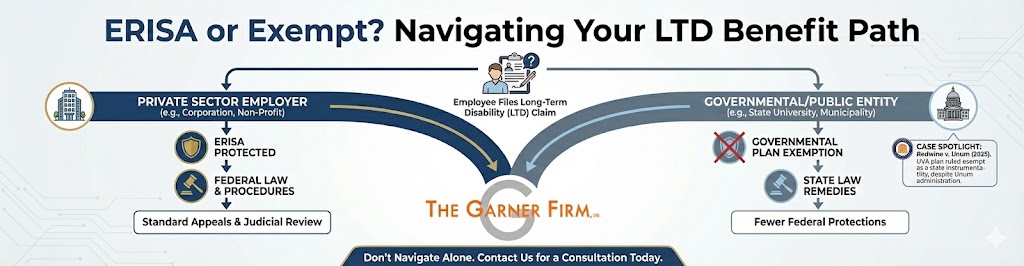
ERISA was enacted to protect the interests of employees and their beneficiaries in employee benefit plans by establishing minimum standards for plan administration, funding, and fiduciary conduct. However, ERISA does not apply to all employee benefit plans. Under 29 U.S.C. § 1003(b)(1), ERISA’s provisions do not apply to a “governmental plan.”
A “governmental plan” is defined as “a plan established or maintained for its employees by . . . the government of any State or political subdivision thereof, or by any agency or instrumentality of any of the foregoing.” Plans that qualify as governmental plans are exempt from ERISA regardless of whether they are administered by private insurance companies. This means that employees of state universities, public schools, municipalities, and other governmental entities typically cannot bring ERISA claims for wrongful denial of benefits. Instead, the claims are brought under applicable state laws.
The Court’s Analysis in Redwine
The court in Redwine conducted a straightforward analysis to determine whether the UVA Medical Center’s benefit plan was a “governmental plan” exempt from ERISA. The court first noted that there was no question UVA established and maintained the plan for its employees’ benefit, as Redwine expressly alleged he was a UVA employee participating in a benefit plan “sponsored by the University of Virginia.”
The critical issue was whether UVA and its Medical Center qualified as “agencies” or “instrumentalities” of the Commonwealth of Virginia. The court found this question easily resolved, citing Virginia state court decisions establishing that UVA is a governmental entity whose powers and duties are created by statute and controlled by the General Assembly. The court also cited precedent specifically recognizing UVA’s Medical Center as an “organ of the state.”
Rejecting the Plaintiff’s Arguments
Redwine advanced three arguments in an attempt to salvage his ERISA claim, all of which the court rejected. First, Redwine argued that if the plan were truly exempt, Unum An experienced ERISA attorney could have presented stronger arguments to preserve the claim.should have disclosed that fact from the outset. The court found no statutory requirement that plans disclose their exempt status and held that Redwine’s assertion did not create a legal duty where none existed.
Second, Redwine contended that because Unum administered the plan, paid benefits under a policy that referenced ERISA, and applied ERISA procedures, the plan should not be exempt from ERISA’s coverage. The court noted that the plan’s reference to ERISA specifically contemplated that ERISA might not apply to all plans and plan-holders, stating the plan “is governed by the laws of the governing jurisdiction and to the extent applicable by [ERISA].”
Third, Redwine argued that the plan was not a “governmental plan” because Unum—not UVA—maintained and administered it. The court rejected this argument, emphasizing that the relevant question is whether UVA “established and maintained” the plan for its employees. A private insurer’s involvement as the plan’s administrator does not impact a plan’s governmental status if it is established and maintained by an agency or instrumentality of a state. The court cited its own prior decision in Rowe v. Rector \& Visitors of the University of Virginia, which found a UVA plan to be governmental even when administered by a private insurer.
What This Means for Employees and Employers
The Redwine decision illustrates an important but often misunderstood aspect of ERISA law: not all employer-sponsored benefit plans receive ERISA protections. Employees of state universities, public schools, municipal governments, and other governmental entities who are denied LTD benefits by insurers like Unum may have claims arising under state law, including insurance bad faith law. However, consulting with an ERISA attorney is essential to understand all available legal options and remedies.
Unum’s Track Record in LTD Claims
It is worth noting that Unum has a well-documented history of problematic claims handling practices. Numerous court rulings have found Unum’s denials to be wrongful, and it is subject to a regulatory settlement agreement with state insurance commissioners and the Department of Labor.
While the Redwine court did not reach the merits of whether Unum properly denied the plaintiff’s claim, it noted that “Unum considered Redwine’s claim on its merits and denied his claim because he did not meet the criteria for the long-term benefits he sought.” It is unclear whether the plaintiff in Redwine will be granted leave to amend his Complaint and assert his claims under state law.
How an ERISA Attorney Can Help
At The Garner Firm, our ERISAattorneys have extensive experience handling complex ERISA litigation involving LTD benefits denials, as well as non-ERISA LTD claims. We understand the nuances of ERISA law, including critical threshold issues such as the governmental plan exemption. Our firm has successfully represented clients in disability benefits cases against major insurers, including Unum, and we are skilled at navigating the procedural complexities that can make or break a case.
Whether you are a private sector employee whose ERISA-governed LTD benefits have been wrongfully denied, or a governmental employee seeking to understand your legal options under state law, The Garner Firm can provide the knowledgeable representation you need. Our LTD attorneys stay current on the latest developments in ERISA case law and are prepared to fight for your rights to obtain the benefits you deserve.
Contact Us Today
If your long-term disability benefits have been denied, time is of the essence. Deadlines for filing administrative appeals and lawsuits are strictly enforced, and missing a deadline can permanently bar your claim. Do not navigate this complex area of law alone. Contact The Garner Firm today to schedule a consultation and learn how we can help you pursue the LTD benefits you need and deserve. Our experienced attorneys are ready to evaluate your case and provide strategic guidance tailored to your unique circumstances.
This blog post is for informational purposes only and does not constitute legal advice. Every case is unique, and outcomes depend on specific facts and circumstances.